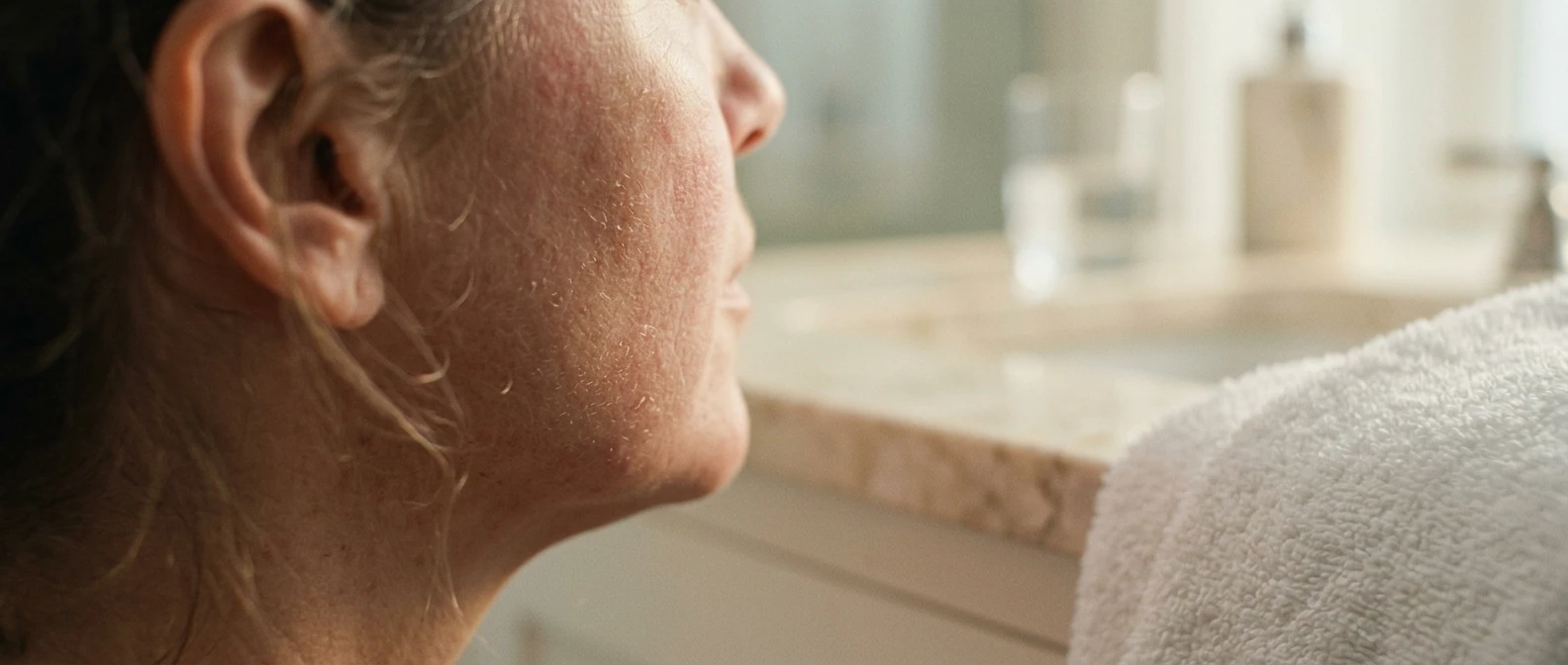
Red, tight skin that stings when you apply moisturizer and sheds flakes onto your collar is a common result of acne treatment. It can also be discouraging, especially if you are in your 40s, 50s or beyond and notice that the dryness makes every fine line look deeper. This guide covers how to soothe skin after acne treatment: what to stop, what to add back and in what order, and when to call the person who prescribed it.
If you had a professional peel, follow the aftercare instructions from your provider first. Where they differ from anything here, theirs win.
Why your skin feels raw after acne treatment (and why it’s usually temporary)
Retinoids, benzoyl peroxide, salicylic acid and peels all work by changing the outer layer of your skin. Some speed up how quickly cells shed, some dissolve the bonds between dead cells, and some dry out the oil that clogs pores. Those same effects thin out the skin’s protective barrier, the layer of cells and natural fats that holds water in and keeps irritants out.
When that barrier is compromised, water escapes faster and nerve endings sit closer to the surface. That produces the tightness, the stinging, the redness and the flaking. Products you tolerated last month may suddenly burn.
Skin also tends to hold less oil as we age, so mature skin can feel the dryness more sharply and take longer to settle. Dehydrated skin makes fine lines and crepey texture look more pronounced. That effect is usually temporary: when the barrier recovers and the skin is well hydrated again, lines typically look softer than they did at the worst of the dryness.
For most people, this kind of irritation eases once the skin gets a break and steady moisture. The sections below show how to give it both.
The first few days: what to pause so your skin barrier can recover
The fastest way to help a stressed barrier is to stop adding to the stress. For the next several days, set aside:
- Retinoids, including retinol and prescription tretinoin or adapalene
- Benzoyl peroxide and salicylic acid products, including cleansers, spot treatments and pads
- Glycolic, lactic and other exfoliating acids
- Physical scrubs, cleansing brushes and rough washcloths
- Toners or astringents that contain alcohol, witch hazel, menthol or fragrance
- Clay masks and any mask that dries down or tingles
- Facial hair removal, such as waxing or threading, until the redness is gone
One caution: if a doctor prescribed your treatment, call the office before you stop it. Many prescribers will happily tell you to skip nights, reduce the amount or take a short break, but they should know what you are doing. Pausing a prescription on your own can let breakouts return, and you want a plan for that.
Cleansing needs a lighter hand too. Use lukewarm water, never hot. Wash with your fingertips, rinse thoroughly and pat your face dry with a soft towel instead of rubbing. In the morning, rinsing with water alone is fine if your skin feels clean and tight when you wash it. For what to look for in a cleanser while your skin is sensitive, see our guide to gentle cleansers for sensitive, breakout-prone skin.
Moisturizer, ceramides and hydration: what to look for on the label
During recovery, your moisturizer does most of the work. Choose it for what is in it and also for what is missing.
Ingredients worth looking for:
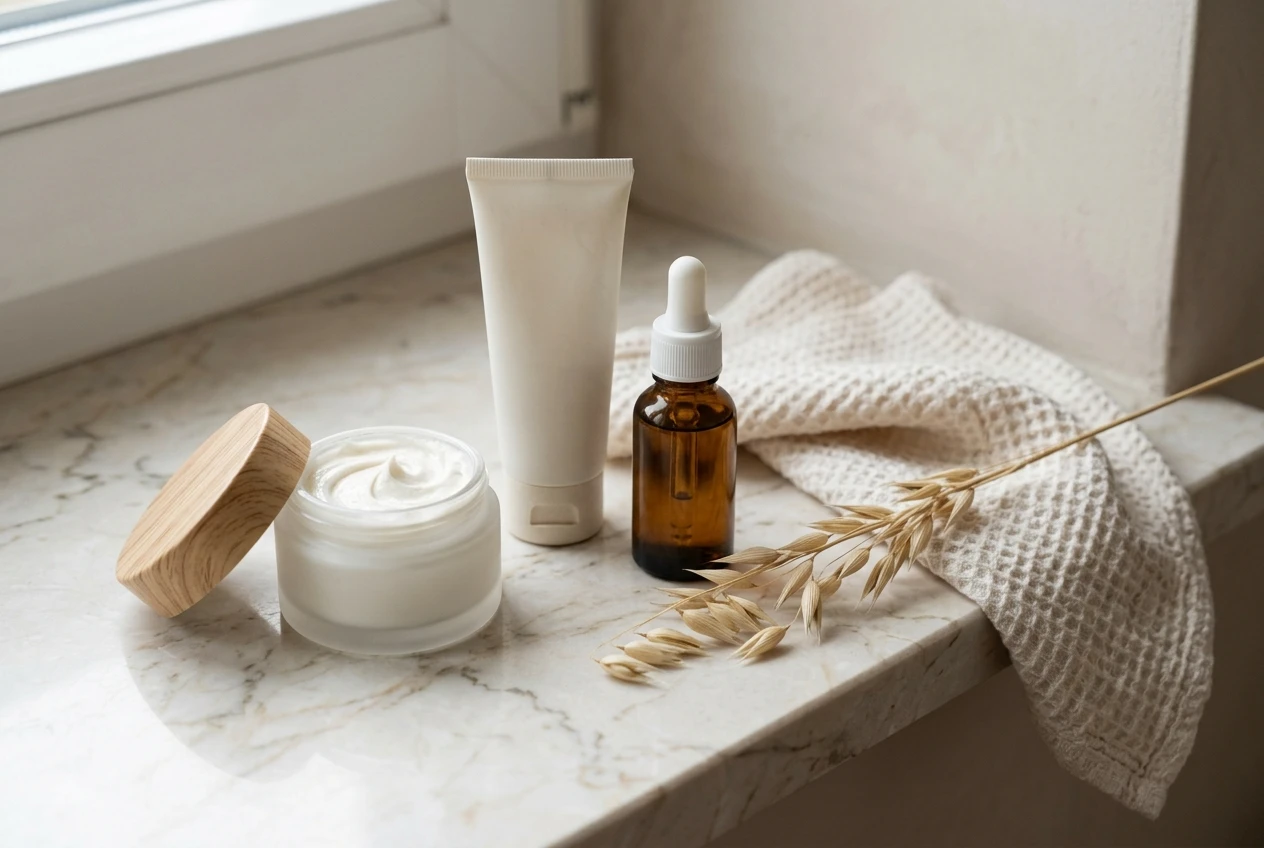
- Ceramides, cholesterol and fatty acids: these are the fats that naturally sit between skin cells, and replacing them supports the barrier.
- Glycerin and hyaluronic acid: both draw water into the outer skin.
- Petrolatum, squalane and shea butter: these soften skin and slow water loss.
- Panthenol (vitamin B5), allantoin and colloidal oatmeal: commonly used to soothe irritated skin.
Ingredients to avoid for now:
- Added fragrance and essential oils
- Menthol, camphor and peppermint
- Denatured alcohol listed high on the ingredient list
- Exfoliating acids and retinol, which some “anti-aging” moisturizers contain
Read the full ingredient list, not just the front of the jar. “Unscented” can still include masking fragrance, while “fragrance-free” is the cleaner claim. If you are prone to breakouts, a “non-comedogenic” label is a helpful hint, though it is not a guarantee, so watch how your skin responds.
Texture matters as well. A cream or ointment-style moisturizer usually protects better than a thin lotion when skin is this dry. Apply it within a minute or two of washing, while your skin is still slightly damp, so it holds that water in. If a single layer is not enough, you can add a hydrating serum underneath, then seal it with the cream.
How to calm redness and stinging without reaching for more actives
When your face is red and burning, the instinct is to buy something stronger to fix it. A new active ingredient on stressed skin often makes the stinging worse, so the better move is to calm things down with as little as possible.

A few simple options:
- A cool compress. Soak a clean, soft cloth in cool water, wring it out and rest it on your face for a few minutes. Avoid ice directly on skin.
- A thicker layer of bland moisturizer. Slightly more cream at bedtime often relieves tightness by morning.
- Soothing ingredients. Centella asiatica, panthenol, allantoin and colloidal oatmeal appear in many fragrance-free recovery creams.
- A little humidity. If your bedroom air is very dry, a humidifier may help your skin hold moisture overnight.
- Cooler showers. Hot water and steam strip oils and bring redness back, so keep your face out of the direct stream.
Introduce nothing new on more than one part of your face at a time, and test any new product on a small patch near your jaw for a couple of days before using it more widely. If something stings the moment it touches your skin, wash it off and set it aside.
For a broader approach to keeping a sensitive routine small and steady, our post on a skincare routine for sensitive skin goes deeper.
Dealing with flaking: why scrubbing makes it worse and what to do instead
Flakes are dead skin cells that your treatment loosened before the skin underneath was ready to replace them. Rubbing them off feels satisfying, but it pulls away cells that are still partly attached and takes the skin underneath with them. The result is more redness, more stinging and sometimes small raw patches that take longer to heal.
Here is what helps instead:
- Moisturize more often. Softened flakes lift and shed on their own. Reapply a thin layer of cream to the flaky areas during the day if they feel tight.
- Use an ointment on stubborn patches at night. A small amount of petrolatum-based ointment over your moisturizer seals water in while you sleep.
- Press, don’t rub. If you wear makeup, apply it with a clean sponge or fingers using a patting motion, and wait a few minutes after moisturizer so it sits smoothly.
- Skip the powder. Powder clings to dry patches and highlights them.
- Leave the picking alone. Picking at flakes can leave marks that last longer than the dryness itself.
Flaking usually fades gradually as the barrier recovers. If you would like to exfoliate again, that comes later, once your skin is comfortable, and it is covered in the reintroduction section below.
Sunscreen when your skin is tender: gentle options and daily habits
Skin that has just been treated with retinoids, acids or a peel is more vulnerable to sun, and sun exposure can deepen redness and leave dark marks that last well beyond the irritation. Sunscreen stays on your list even when everything else is paused.
Mineral sunscreens, made with zinc oxide or titanium dioxide, are generally better tolerated by sensitive, reactive skin than chemical filters. Look for a fragrance-free, broad-spectrum formula with an SPF of 30 or higher. Many mineral formulas leave a slight white cast, and a fragrance-free tinted version can help if that bothers you.
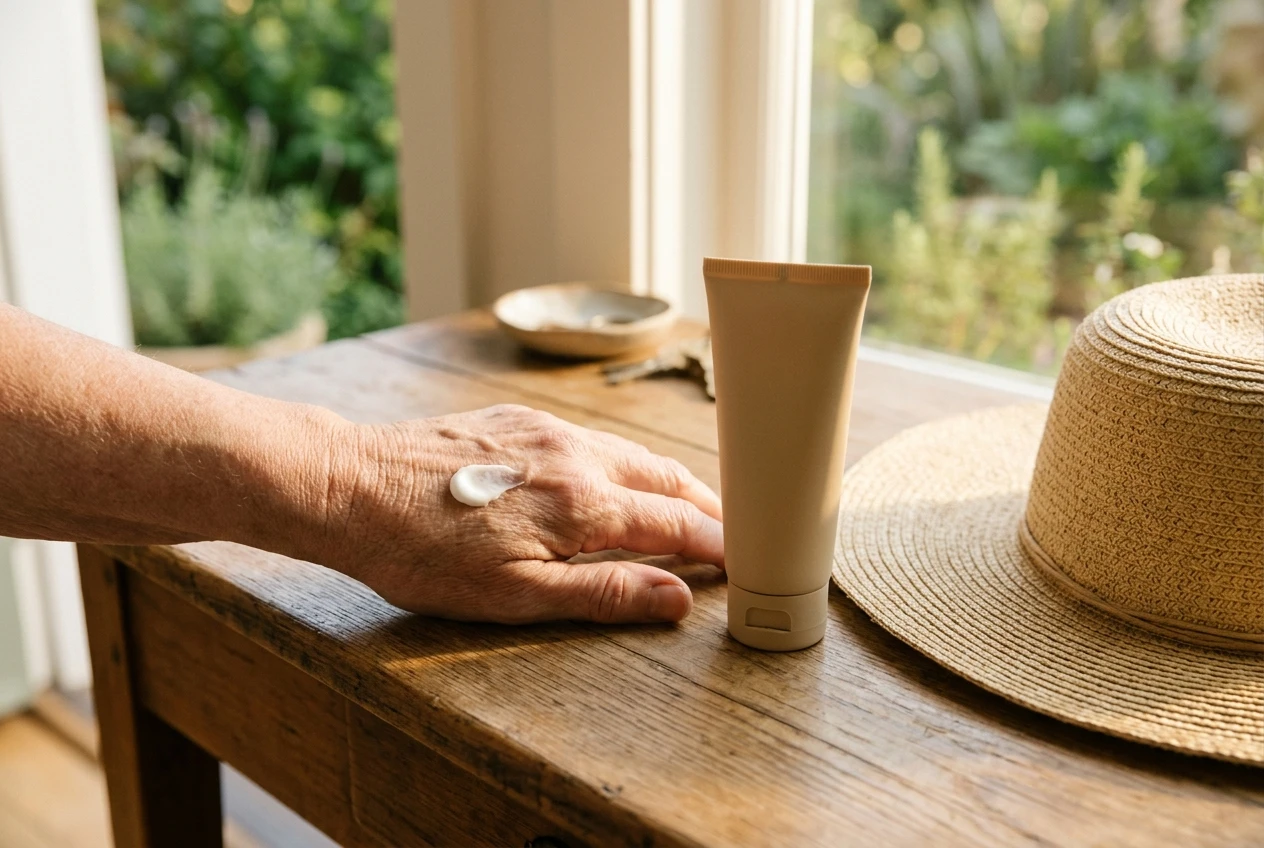
Some habits make the daily routine easier:
- Apply sunscreen as the last step of your morning routine, after moisturizer has absorbed.
- Use a generous amount, and cover your ears, neck and the backs of your hands, since these areas are easy to forget.
- Reapply if you are outdoors for a long stretch.
- Wear a wide-brimmed hat and sit in the shade when you can, which gives the skin extra protection without touching it.
- If a sunscreen stings around your eyes, switch to a mineral formula or use a separate, gentler product there.
If your skin is too tender to tolerate any sunscreen, ask your prescriber or dermatologist what they recommend, and limit sun exposure in the meantime.
How to bring your treatment back in slowly, and when to check in with your doctor
Once your skin has felt comfortable for several days in a row, meaning no tightness after washing, no stinging when you apply moisturizer and little or no visible flaking, you can think about restarting.
Bring things back one at a time, in this order:
- Restart your treatment at a lower frequency. For example, use it every third night instead of nightly, if your prescriber agrees.
- Buffer it. Apply moisturizer before and after the active product to soften its effect.
- Use a smaller amount. A thin layer is enough.
- Increase only when your skin handles it. Add a night when your skin has stayed calm through the previous schedule for a week or so.
- Hold off on extra exfoliants. Resume acids, scrubs and peels last, and only if you still want them.
If you are watching for breakouts to return while your treatment is on hold, our post on adult acne in women over 30 explains why they happen and how to calm them gently.
Contact your prescriber or dermatologist if you notice any of the following:
- Blistering, oozing or crusting
- Swelling of the face, eyelids or lips
- Severe or increasing pain, or a burning that does not settle
- Signs of infection, such as spreading warmth, pus or yellow crusts
- A rash or hives after starting a new product
- Redness and peeling that keep getting worse instead of gradually easing, or that have not improved after a week or two of gentle care
Mention the products you have been using, including over-the-counter ones. Sometimes the fix is a lower strength, a different formulation or a different schedule rather than giving up on treatment altogether.
A simple recovery routine you can follow morning and night
Keep this routine for as long as your skin feels sore, and move on to the reintroduction steps only when it feels comfortable.
Morning
- Rinse your face with lukewarm water, or use a gentle, fragrance-free cleanser if your skin feels oily.
- Pat dry with a soft towel, leaving the skin slightly damp.
- Apply a hydrating serum if you use one, such as one with hyaluronic acid or glycerin.
- Apply a fragrance-free moisturizer with ceramides.
- Finish with a mineral sunscreen, SPF 30 or higher.
Night
- Remove sunscreen and makeup with a gentle, fragrance-free cleanser and lukewarm water.
- Pat dry and leave the skin slightly damp.
- Apply a hydrating serum if you use one.
- Apply a generous layer of ceramide cream.
- Dab a thin layer of ointment over any flaky or very tight spots.
Keep everything else out of the routine until your skin is calm. A slow, boring routine is the fastest way to a comfortable face again, and it protects the results your treatment was meant to give you.
If you would like a printable version of this routine to keep by the bathroom sink, join the email list and you will get a free gentle recovery routine checklist you can follow day by day while your skin heals.