If you are over 30 and your chin and jawline keep breaking out in the same few spots, you have probably wondered about your plate. It is a natural question. Hormonal breakouts feel like they come from the inside, so it makes sense to look at what goes in.
So, does diet cause hormonal acne in women? The honest answer is that food can play a part for some people, but it is rarely the whole story, and research has not settled how big the part is. This article walks through what is reasonably well discussed, what is still unproven, and how to run a low-pressure experiment on your own skin without banning anything.
If you want the outside-of-the-body side of recurring breakouts first, why you’re breaking out again at 40 covers that. This piece looks only at the inside.
Why hormonal breakouts make us look at the plate
Hormonal acne tends to show up along the lower face, often in deep, tender spots that surface slowly and heal slowly. It often follows a pattern linked to the menstrual cycle, stress, or life stages such as coming off birth control, pregnancy, or perimenopause.
Because the trigger seems to be hormones, and hormones respond to many things in the body, food becomes an obvious suspect. Wellness websites and social media make it louder. Almost every woman with stubborn skin has been told to cut out dairy, sugar, gluten, or all three.
That advice is often delivered with total confidence. The research is more modest, and knowing where the evidence is solid and where it is thin will save you from chasing a restrictive diet that may not help.
What we actually know (and don’t) about food and acne
For a long time, dermatology textbooks said diet had nothing to do with acne. That position has softened. Over the past couple of decades, researchers have looked more closely at eating patterns, and some studies have found links between certain patterns and acne.
Here is a fair summary of where things stand:
- Some links have been observed. Studies have associated higher-glycemic eating patterns and some dairy intake with acne in some groups of people.
- Many of those studies are observational. They show that two things appear together, not that one causes the other. People who eat a lot of sugary foods may also sleep less, feel more stressed, or differ in other ways that affect skin.
- Most of the research is not on women over 30. A lot of it involves teenagers and young adults, so results do not translate neatly to adult hormonal acne.
- Individual responses vary. One person may notice a pattern with certain foods, and another may notice nothing at all.
What this means in practice: food is a plausible factor for some people, an unproven one for others, and almost never the only one. Genetics, hormone levels, skin sensitivity, stress, sleep, and skincare habits all contribute.
It also means that no single food, supplement, or diet has been shown to clear hormonal acne in women. Anyone promising that is selling something.
Blood sugar swings and the skin: the connection people talk about most
The most discussed idea is that foods which raise blood sugar quickly may worsen acne. The reasoning goes like this: when blood sugar rises sharply, the body releases more insulin. Higher insulin levels may increase the activity of hormones called androgens and a growth factor called IGF-1, and both can make the skin’s oil glands more active. More oil and more clogged pores can mean more breakouts.
This is a proposed explanation, and researchers continue to study it. It is not a proven chain of events in every person. Still, it is the idea with the most discussion behind it, and it has one useful feature: eating in a way that keeps blood sugar steadier is good for you whether or not your skin responds.
Foods that tend to raise blood sugar quickly include white bread, sugary drinks, pastries, sweets, and large portions of refined starches eaten alone. Foods that tend to raise it more slowly include whole grains, beans and lentils, vegetables, nuts, and meals that combine carbohydrates with protein, fiber, or fat.
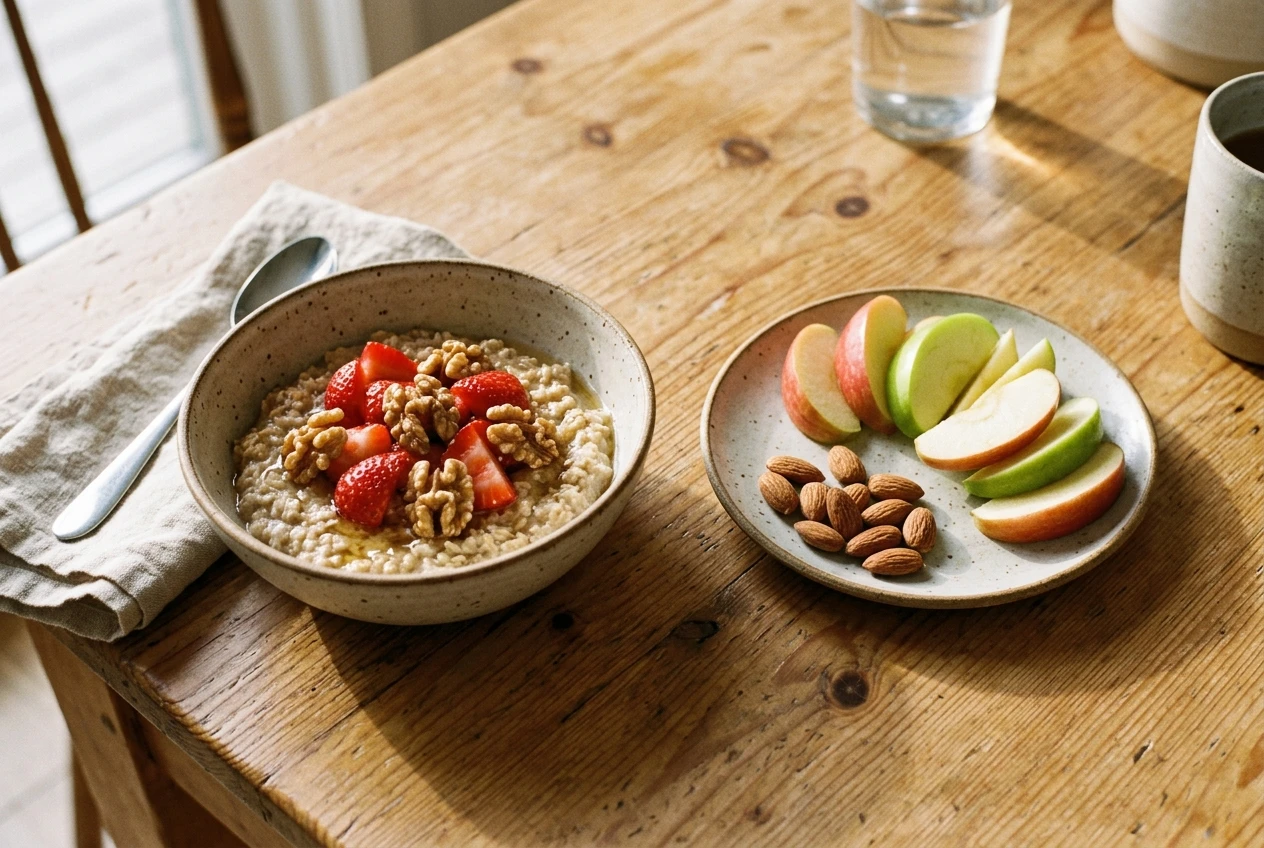
You do not need to give up bread or dessert. Small shifts are enough for an experiment, such as having fruit with a handful of nuts rather than on its own, or choosing oats over a sugary cereal on a few mornings. If your skin changes over several weeks, you have learned something. If it does not, you have lost nothing.
Dairy, sugar and other usual suspects: how to think about them without panic
Dairy gets the most attention after blood sugar. Some studies have found an association between milk consumption, skim milk in particular, and acne. The possible explanations include hormones naturally present in milk and the way dairy can affect insulin and IGF-1. The evidence is mixed, and it does not show that dairy causes acne in every woman. Plenty of people eat dairy and have clear skin.
Sugar is often grouped with dairy as a trigger, partly because of the blood sugar connection above. Added sugar is worth noticing, though noticing is different from fearing it.
A few other foods come up in conversation:
- Whey protein supplements. Some people report breakouts after starting them, and a link has been discussed. If you use one and your skin changed around the same time, it is worth adding to your diary.
- Gluten. There is no solid evidence that gluten causes acne in people without a gluten-related condition.
- Chocolate and greasy food. These are the classic myths. Evidence for chocolate is limited and inconsistent, and eating oily food does not put oil in your pores.
A useful way to think about any of these is as a question, not a verdict. “Could this be affecting my skin?” is a good question. “I must never eat this again” is a conclusion the evidence does not support, and cutting out whole food groups can make eating stressful and may leave gaps in your nutrition.
If you have any history of disordered eating, or if tracking food tends to make you anxious, skip the diary below and talk to a doctor or registered dietitian instead. Your skin is not worth that trade.
Your gut, your stress and your skin: the quieter factors
Two other areas are getting research attention, and both are less about specific foods than about overall wellbeing.
Gut health. Scientists are studying a possible connection between the bacteria in the digestive system and skin inflammation, sometimes called the gut-skin axis. The research is early. Some small studies on probiotics and acne exist, but it is too soon to say that any particular probiotic or fermented food will clear your skin. Eating a varied diet with plenty of fiber from plants is generally good for digestion, and it is a reasonable thing to do while the science develops.

Stress and sleep. Stress raises cortisol, and under stress the body can produce more of the hormones that stimulate oil glands. Poor sleep tends to go along with higher stress and with cravings for quick-energy foods. So a food diary may show a pattern that has more to do with a hard week than with the food itself. A bad week at work might bring both a pizza dinner and a breakout, and the pizza may not be the cause.
That overlap is why it helps to track more than food. Noting your sleep, stress, and cycle gives you a fuller picture.
A kind, simple food-and-skin diary you can try for four weeks
The aim of a diary is to notice patterns, not to prove anything. Keep it small enough that you will actually do it. A notes app or a cheap notebook is enough.

Week 1: just observe
Change nothing. Each day, write down:
- What you ate, in broad terms (a few words per meal is fine)
- Your skin that day: new breakouts, tenderness, oiliness
- Sleep, rated roughly good, okay, or poor
- Stress, rated low, medium, or high
- The day of your cycle, if you have one
This week gives you a baseline. Many people find they notice things simply by writing them down.
Weeks 2 and 3: change one small thing
Pick a single change, not three. Some gentle options:
- Swap sugary drinks or snacks for lower-sugar ones on most days
- Pair carbohydrates with protein or fiber at meals
- Reduce dairy to a smaller amount rather than removing it, for example choosing a non-dairy option in your coffee
Keep your skincare routine the same throughout. If you change products at the same time, you will not know which change made the difference.
Week 4: look back
Read through your notes. Ask yourself:
- Did new breakouts appear more or less often than in week 1?
- Did spots seem to follow certain foods, or did they follow your cycle, poor sleep, or stressful days?
- Did the change feel sustainable, or was it a strain?
One honest limit: hormonal breakouts often take weeks to surface and weeks to fade, and a single month, covering about one cycle, is a short window. If you see no clear pattern, that is useful information too. If you see a hint of one, you can run the experiment for another month before drawing conclusions.
When food is not the answer and it’s time to talk to a doctor or dermatologist
Diet changes are an optional extra. They should not replace medical care when you need it. Consider booking an appointment if you notice any of the following:
- Deep, painful nodules or cysts that linger for weeks
- Scarring or dark marks that are staying behind
- Breakouts that started suddenly, or got much worse, with no clear reason
- Irregular or absent periods, or noticeably increased hair growth on the face or body, or thinning hair on the scalp, which can sometimes point to a hormonal condition worth checking
- Breakouts that have not responded to a consistent, gentle routine after a couple of months
- Skin problems that are affecting your mood or confidence
A doctor or dermatologist can check for underlying causes and discuss treatments that have good evidence behind them, some of which work on hormones directly. Bringing your food diary to the appointment can give them extra context.
Pairing inside care with a calm outside routine
Whatever you learn from your diary, your skin still needs gentle care on the outside. Harsh scrubbing and stripping products can leave breakout-prone skin irritated, which makes everything harder to read, including your food experiment. A simple routine keeps the other variables steady while you observe.
If you are looking for a starting point, the guide to gentle cleansers for sensitive, breakout-prone skin explains what to look for and what to skip.
If you would like some structure for the experiment above, join the email list and you will receive a free, gentle skin-and-food diary printable, plus weekly calm-skin tips straight to your inbox. It is the same four-week plan, laid out on a page, with no rules about what you must or must not eat.