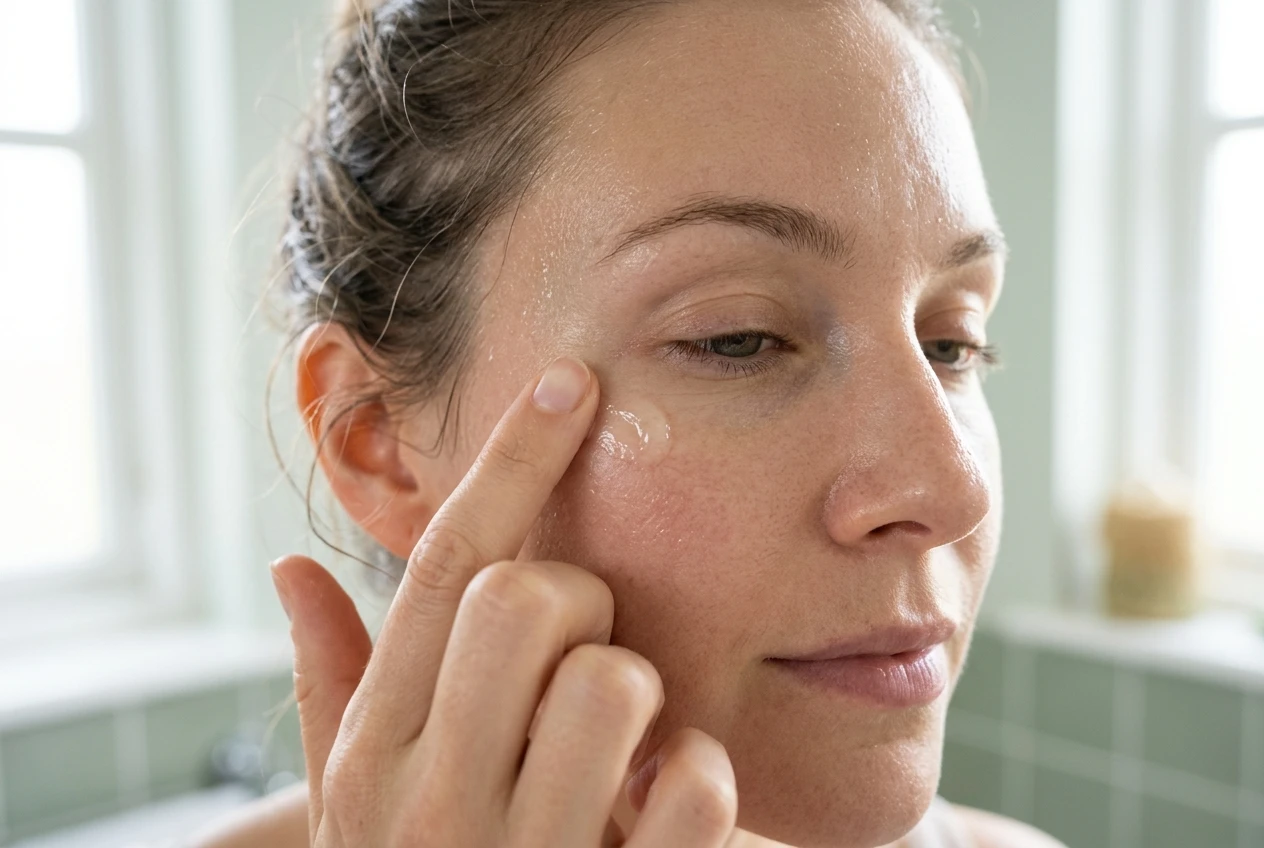
A morning and night skincare routine for crow’s feet is one of the easiest ways to soften the first lines many women notice. You do not need ten products. You need a few that do clear jobs, used in a sensible order and added slowly. This article lays out a morning and night skincare routine for crow’s feet that you can follow as a checklist, with extra notes for skin that stings easily.
Why crow’s feet show up first, and what a routine can and can’t do
The skin at the outer corner of your eye is thin and has fewer oil glands than skin on the cheeks or forehead, so it dries out faster. It also moves constantly. Every smile, squint and laugh folds it, and over many years repeated folding leaves lines that stay after the expression fades. Sun exposure breaks down the skin’s collagen and makes those lines settle in sooner.
That tells you what a routine can do. It can keep the area hydrated, which softens the look of fine lines. It can protect against the sun, which slows new damage. And with a retinoid-style active or peptides, it can gradually improve the skin’s texture.
It cannot erase deeper lines created by years of expression. If those are your main concern, a dermatologist can talk through options beyond skincare. For most of us, though, the goal is softer, smoother-looking skin and fewer new lines, and a steady routine is a good way to get there.
The checklist in short:
- Morning: cleanse gently, hydrate, moisturize, apply sunscreen, wear sunglasses.
- Night: cleanse gently, hydrate, apply an eye-area active a few nights a week, then moisturize.
- Pacing: add one new product at a time and give each one about two weeks.
Your morning routine: cleanse, protect, and hydrate the eye corners
Morning skin does not need much cleaning. Overnight your face collects very little, so a splash of lukewarm water or a mild cleanser is enough. If your skin feels tight after washing, the cleanser is too strong. Our guide to gentle cleansers for sensitive skin explains what to look for on the label.
Here is the morning order:
- Cleanse. Use lukewarm water and your fingertips. Pat dry with a clean towel instead of rubbing, because friction at the eye corners adds up over time.
- Hydrate. While your skin is still slightly damp, press a hydrating eye product into the outer corners. Hyaluronic acid and glycerin pull water into the top layer of skin, and damp skin gives them water to draw in.
- Moisturize. A fragrance-free moisturizer seals that water in. Many women find a regular face cream is fine around the eyes. If it makes your eyes water or sting, switch to one labeled for the eye area.
- Protect. Sunscreen goes last, covered in the next section.
Use your ring finger for the eye area. It naturally presses more lightly than your index finger. Dab, don’t drag, and stop at the bony ridge around the eye rather than getting close to the lash line.
Sunscreen and sunglasses: the step that matters most for prevention
If you do only one thing from this list, make it this one. Ultraviolet light is a major driver of fine lines, and the eye corners get a lot of exposure, even on cloudy days and through car windows.
Choose a broad spectrum sunscreen with SPF 30 or higher, and apply it every morning, including the outer corners of your eyes. A small amount dabbed along the bone around the eye, then gently blended, is enough. Sunscreen that migrates into the eye can sting, so avoid applying it right at the lash line.
If your eyes are sensitive, try a mineral sunscreen with zinc oxide or titanium dioxide. Mineral formulas tend to bother eyes less than many chemical ones, though individual reactions vary. If you worry that sunscreen will clog your pores, our piece on sunscreen that won’t make you break out goes through what to look for.

Sunglasses do two jobs. They block UV light, and they stop you from squinting in bright light, which is the very motion that creases the corners. Look for a label saying they block 100 percent of UVA and UVB rays (some say “UV400”). Larger lenses and wraparound frames cover more of the skin around your eyes. Keep a pair by the door and one in the car so you don’t have to remember them.
Reapply sunscreen on your face if you are outdoors for a long stretch. Over makeup, a sunscreen stick or powder can make this easier.
Your night routine: where the real smoothing work happens
Skin repairs itself while you sleep, and night is also the safest time for ingredients that make you more sun sensitive. This is where you do the active work on lines.
The night order:
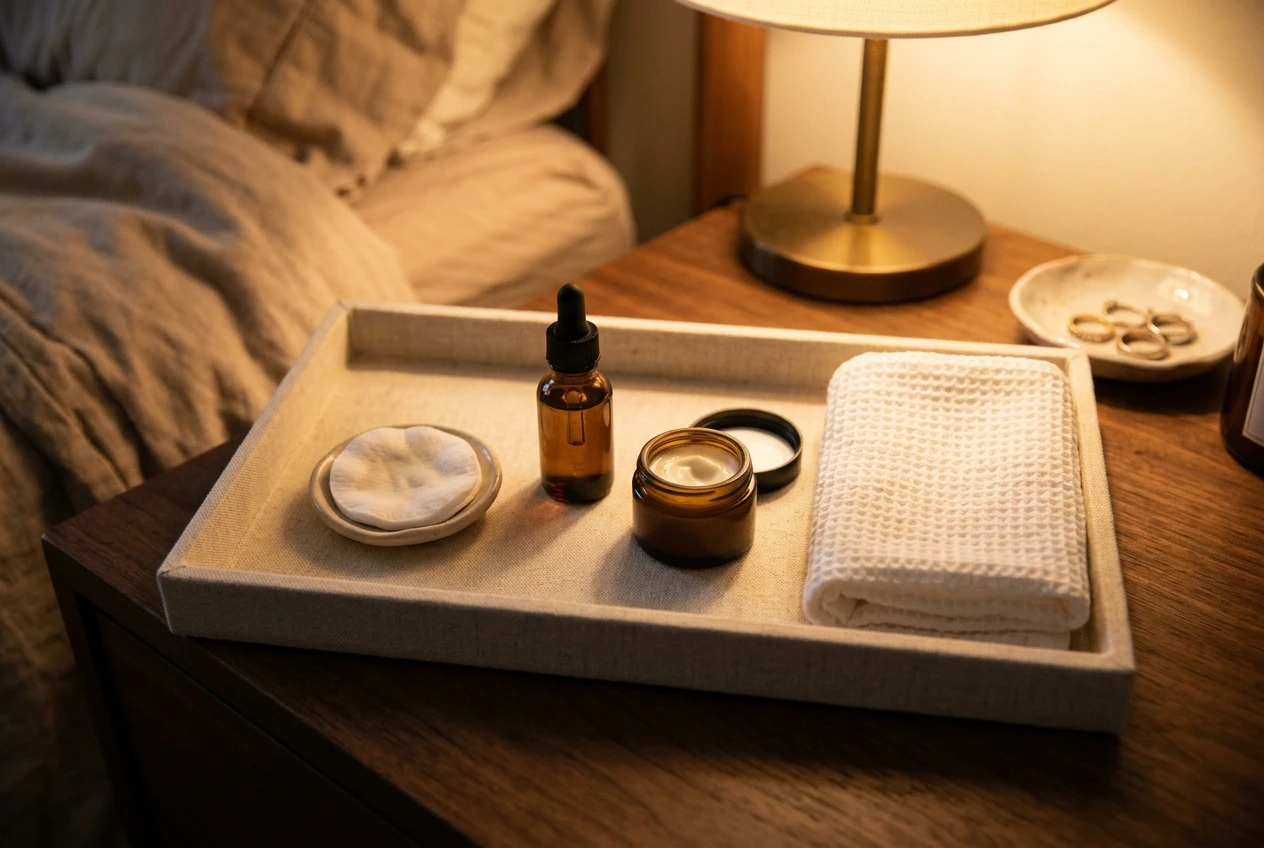
- Remove sunscreen and makeup. Use a gentle cleanser. If you wear eye makeup, soak a cotton pad with a mild remover, hold it on the lid for a few seconds, and wipe once softly. Rubbing back and forth pulls at the skin you are trying to protect.
- Cleanse your face with lukewarm water and a mild cleanser, then pat dry.
- Wait a few minutes if you are using a retinoid. Applying it to fully dry skin tends to cause less stinging than applying it to damp skin.
- Apply your eye-area active on the nights your schedule allows (more on that below). Use a tiny amount, tapped along the outer corner and the bone below, not on the lid itself.
- Hydrate and moisturize. A hyaluronic acid product followed by a fragrance-free cream or eye cream finishes the routine and reduces dryness from the active.
On nights you skip the active, do steps 1, 2 and 5 only. Those rest nights keep your skin from being overworked, and they matter as much as the nights with the active.
Choosing an eye area active if your skin is sensitive
An “active” is an ingredient that changes how skin behaves, not just how it feels. For crow’s feet, three groups are worth knowing.
- Retinoids (retinol, retinal, and prescription options such as tretinoin) are the most studied ingredients for fine lines. They help skin renew itself and support collagen. They are also the most likely to cause dryness, redness and peeling, especially near the eyes. If you are pregnant, trying to conceive or nursing, ask your doctor before using one.
- Peptides are short chains of amino acids that signal skin to behave in a firmer, smoother way. They are generally well tolerated, which makes them a good first choice if your skin reacts to many things.
- Hydrators such as hyaluronic acid, glycerin and ceramides plump the surface and support the skin barrier. They are not strictly actives, but they make everything else easier to tolerate.
If your skin is sensitive, begin with a peptide or a low-strength retinol made for the eye area, or a gentler retinoid-style option. Our article on retinol alternatives for sensitive skin covers the milder options in more detail.
Look for products without added fragrance and essential oils, which are common triggers for irritation at the eye. A short ingredient list is usually easier to troubleshoot. If you want to use a retinoid on your whole face, a pea-sized amount is enough for the whole face, and the eye corners only need a thin leftover layer.
How to add one new product at a time without irritation
When you start three products in the same week and your eyes turn red, you cannot tell which product caused it. Adding one at a time solves that problem, and it gives your skin barrier time to adjust.
Follow this pattern for each new product:
- Patch test first. Put a small amount behind your ear or on your inner forearm for two or three days. If you see redness, itching or swelling, don’t use it.
- Use it once, then wait. Apply it on the first night, then see how your skin looks the next morning.
- Start with a small area. Use it only at the outer corners before you extend it anywhere else.
- Give it about two weeks before you add anything else. Skin reactions can show up a few days after a product is introduced.
- Introduce only one change at a time, and that includes switching cleansers or sunscreens.
It is tempting to rush because results from retinoids and peptides take weeks to show. Rushing is also the most common reason people quit and decide a product “doesn’t work for them.” A calmer pace gets you further. Our post on a calmer routine for sensitive skin goes deeper on this idea.
A week-by-week way to start, plus signs to slow down
Here is one way to build the routine over about six weeks. Adjust it to your skin; slower is fine.

- Weeks 1 and 2: Base routine only. Gentle cleanser, moisturizer, and sunscreen every morning, plus sunglasses outdoors. If you already use all of these, keep them unchanged.
- Weeks 3 and 4: Add a hydrating eye product (hyaluronic acid or a peptide product), morning and night, after patch testing.
- Week 5: Add your retinoid-style active at night, two nights a week with a rest night between them, tapped on the outer corners.
- Week 6 and beyond: If your skin feels comfortable, move to three nights a week. Hold there for a few more weeks before considering anything more. Many people stay at two or three nights and do well.
Signs to slow down:
- Stinging or burning that lingers after a minute or two
- Redness, flaking or a tight feeling that does not ease with moisturizer
- Itching, or small bumps near the eye
- Makeup that suddenly sits in dry patches
If you notice any of these, stop the newest product for several days and use only cleanser, moisturizer and sunscreen until your skin feels normal again. Then restart with less frequency. If you have swelling, a rash that spreads, or any eye discomfort, stop everything and talk to a doctor or pharmacist.
Gentle extras that support the routine: sleep, hydration, and less squinting
A few habits add to what your products do, and none of them cost anything.
Sleep. Regular, sufficient sleep gives skin time to repair. Sleeping on your back keeps your face from pressing into the pillow for hours, which can crease the skin at the eye corners.
Drinking water. Drinking enough fluid supports your overall health, but it will not by itself smooth lines. Topical hydration does more for the surface, so treat water as support rather than a substitute.
Less squinting. Notice when you squint at a phone or a screen. Raising the text size, adjusting your screen brightness, or having your eyes checked can help. If your glasses prescription is out of date, you may be squinting without realizing it.
Indoor humidity. Dry indoor air in winter pulls moisture from skin. A humidifier in the bedroom can help if your skin feels tight in the morning.
Natural options. If you like to add soothing home care, such as a cool compress, see our post on natural ways to soften crow’s feet for gentle ideas that won’t irritate the eye area.
Crow’s feet respond best to patience. Protect the area every morning, hydrate it twice a day, and bring in an active slowly at night, and you give your skin a fair chance to look smoother over the coming months.
If you would like this routine on paper, join the email list for a free printable morning and night crow’s feet checklist, along with gentle product picks sent straight to your inbox.